Monday, May 21, 2012

Introduction

Elephants are the largest land animals on earth. They have entertained the human population for hundreds of years and are now endangered, specifically the African Elephant which once roamed the entire continent of Africa. In 1930, there were between 5 and 10 million African Elephants and by 1979 down to 1.3 million. When they were added to the endangered list in 1989, 600,000 remained. That's less than 1% of their original number!

Description/ Classification

Photo: African elephant


As the African Elephant is very often mistaken for it's Asian cousin, but it is larger in size and weight.
  •  dark grey in color and a dry crusty skin
  • 14,000 to 16,000 lbs
  • 13 feet tall at the shoulder
  • Sway-backed with a tapering head
  • Tusks- largest male's can be 160 lbs and 12 feet long
  • Trunk- is a long nose used used for smelling, drinking, and breathing. Also uses trunk to grab on to things to feed or break.
The most interesting and exciting thing about this mammal is their ears. The African Elephant's ears match their continent where as the Asians are much smaller and look like the shape of India. There ears radiate heat to help keep cool in the hot humid weather.

Classification:

Common Name: Savanna Elephant 
Kingdom: Animalia
Scientific name: loxodnta africana
Phylum: Chordata
Class: Mammalia
Order: Proboscidea
Family: elephantidae
Genus: loxodanta
Species: african
Body Systems:   Respiratory, Circulatory, Digestive, Integumentary, and Skeletal Systems are all present in the elephant.

Fun Fact: Elephants skin is about an inch thick, but is so sensitive a fly can be felt on it.


Habitat


Elephants are capable of adapting to a variety of different habitats. They can be found in different biomes including deserts, forests, savanas, and whatever other habitats are on their migritory route.

Biome characteristics: Abiotic factors- Water and space to live
                                  Biotic factors- Birth rate, food supply, and predators
Dominant plants: shrubs and isolated trees


Savanna areas

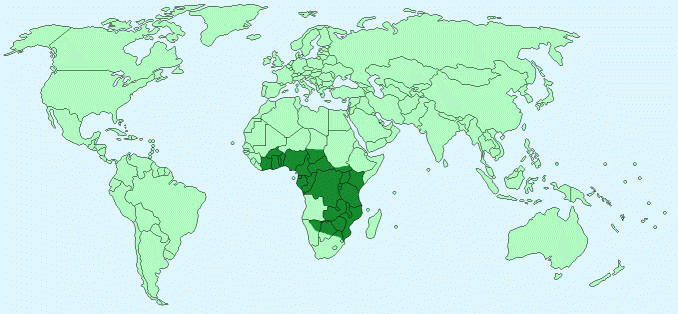
 Geographical Distribution - Central and Southern Africa
 Natural Habitat - Savanna plains, African rainforest

Distribution of African Elephants

Nutrition

 Elephants are Herbivores.
 They eat : about 240-450 pounds per day. They may travel long distances in search for food.
  • Roots 
  • Grasses
  • Fruit
  • Bark     
  

Food Chain

Reproduction

Elephant herds consist of female elephants, their offspring, and males. Once the male elephants reach maturity they tend to travel on their own or join other male herds. Elephant herds are matriarchal, which means that the oldest female of the herd is the leader and decides where to eat, when to travel, and when to rest.
Baby elephants can be a big commitment.  
  • 22 month pregnancy 
  • Female elephants usually give birth to one calf every 2-4 years
  • At birth, calves already weigh 200 lbs and are 3 feet tall
Reproductive Strategist- K-Strategist because of their massive size, longer life span, and their production of fewer offspring which in turn gives them a better chance of survival. They live to be about 55-75 years old.


Picture mother baby elephant 10 Mother and Baby Elephants

Role in the ecosystem

Herbivore
Elephants consume- grass, foliage, fruit, branches, twigs, and tree bark.

Quick Fact- Elephants spend most of their day eating 400 lbs of vegetation each day and drinking about 50 gallons of water.

The elephant is a keystone species. A keystone species is a species on which the persistence of a large number of other species in the ecosystem depends. Large herbivores shape the habitat in which other species live. They important plants that support particular insect species that are prey for birds, pull down trees, break up bushes, and forge trails. For example humans depend on the openings they make in the forests and water holes they dig.

Other organisms in same ecosystem: lions, zebras, giraffes, and many hoofed animals


Threats/ Solutions

Ivory

Causes of Endangerment 
Habitat Loss: Humans have become a direct competitor foe living space. Elephants and humans are not looked at as good neighbors. When humans and elephants live close together elephants raid crops, destroy villages, and scare people because of their aggressiveness during mating season.

Over-exploitation:  This is the main cause of decline in their population. Elephants were prized trophies for big game hunters. The ivory in the elephants tusks can be very valuable to humans. Many have been killed for their tusks. This trade is illegal today but has not been completely eliminated which is why many African elephant populations are endangered. 

The population would keep going down if the mammal is not protected. Even with a law against hunting elephants for their tusks it is still done. If I had unlimited resources to save this animal i would start with cutting down with farmers grazing the land with their cattle. The grazing is eating up the grass lands which results in loss in vegetation and then turns the savanna into a desert. This is a loss of the wild animals natural habitat which is why they are roaming into villages.